Today, December 3, the President of Mexico announced during the morning press conference the increase of the minimum wage for 2026 and highlighted key elements of the Federal Government’s initiative and implementation strategy to reduce the workweek from 48 to 40 hours. According to the announcement, the initiative will be submitted to Congress today for formal presentation before the close of the regular session, and it is expected to be debated in early 2026.
Minimum wage for 2026. The minimum daily wage will be as follows:
Implementation strategy for the reduction of the workweek. The Government presented the framework for a constitutional and legal reform to reduce the weekly workweek to 40 hours without any reduction in wages or benefits. According to the current administration, the proposal was developed through a national dialogue held between June and November 2025, involving more than 40 working groups and approximately 2,000 participants from the labor, business, union, academic, and government sectors.
In line with the recommendations of the International Labour Organization (ILO), the Mexican Government emphasized expected benefits in health, safety, productivity, and quality of life.
Key points discussed during the morning conference include:
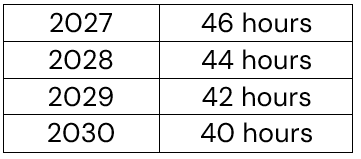
Regarding timing and the implementation schedule, the following was established:
The Government’s proposal contemplates that companies must maintain records of regular and overtime hours to verify compliance, including an electronic timekeeping system to be regulated by the Ministry of Labor and Social Welfare.
The President confirmed that the initiative will be sent today to ensure its formal presentation to Congress despite the proximity to the close of the session. It was also noted that all changes implemented in recent years have resulted from consensus among interested parties, such as the vacation and the subcontracting reforms.
Given the above, it is essential to closely monitor the legislative process expected in 2026 and to prepare in advance for the phased transition that will begin in 2027 and take full effect in January 2030.
Likewise, It will also be necessary to review and, where appropriate, adjust policies applicable to overtime, protocols relating to minors, organizational practices and shift and schedule adjustments, and timekeeping systems to ensure alignment with the new limits without materially impacting companies’ production and productivity.
For any questions or comments, you can contact our expert team.
Legal Notice: This Client Alert is for informational purposes only and does not constitute legal advice or a formal opinion on any specific matter. The information contained herein reflects a general analysis prepared by our attorneys based on information available at the time of publication. Any reproduction, citation, or reference to this content must be expressly attributed to Mijares and should not be construed as a public statement or comment made by the firm to the media.
Awards