On March 19, 2026, President Claudia Sheinbaum, following up on what was presented in her infrastructure plan last February, presented to the Chamber of Deputies the Initiative for the Promotion of Investment in Strategic Infrastructure for Development with Welfare (the "Law"), which establishes a specific legal framework to promote investment, Co-investment and financing of strategic public infrastructure projects with coordinated participation of the public, private and social sectors. It creates vehicles and governance bodies to channel resources, distribute risks and accelerate priority projects, under principles of fiscal stability, transparency, austerity and alignment with national development plans. It contemplates a special regime of procurement, support and benefits, as well as specific reforms to the Federal Law of Budget and Fiscal Responsibility to strengthen planning, registration and accountability of multi-year commitments.
The Law was approved by the Chamber of Deputies on March 25, 2026, and referred to the Senate on the same day. It is expected that on April 7, 2026, the Senate will refer the bill to committees for review and subsequent discussion in the Plenary.
The main aspects of the Initiative are summarized below:
The Law is of public order and general observance throughout the Republic. Its purpose is to regulate investment mechanisms that promote the development and execution of strategic public infrastructure projects, through the participation of the public, private and social sectors, under the principles of Articles 25 and 134 of the Political Constitution of the United Mexican States.
The Law expressly clarifies that it may not be interpreted as:
The subjects of the Law are:
The Law indicates the following as eligible sectors for this support:
The projects must be aligned with the National Development Plan and its programs, seeking to trigger growth, reduce inequality, expand access to basic services and favor sustainable and regional development strategies.
It applies to projects promoted by federal agencies and entities, and by states and municipalities and their public entities, in accordance with their local regulations on financial discipline, budget, accounting and debt.
The Law states that the Ministry of Finance and Public Credit ("SHCP") will be in charge of issuing the guidelines that establish the requirements, limits of resources and their origin, as well as any other requirement that must be considered by the subjects who want to participate in the investment mechanisms. The specific procedures, technical methodologies, formats, operational rules and other aspects of an administrative nature necessary for the application of the Law shall be established in its Regulations and in the guidelines issued by the Ministry.
The Initiative establishes a detailed supplementary application regime, indicating as supplementary legislation in administrative, budgetary and public debt matters: (i) the Federal Law on Budget and Financial Responsibility; (ii) the Federal Public Debt Law; (iii) the General Law of Government Accounting, among others.
In matters of civil, commercial and financial procedure, the Initiative indicates in order of supplementary application: the Federal Civil Code, the National Code of Civil and Family Procedures, the Commercial Code, the Securities Market Law and the General Law of Commercial Companies. Finally, the Law indicates as a supplementary application the Law on Acquisitions, Leases and Services of the Public Sector, the Law on Public Works and Services Related to the Same and the Law on Roads, Bridges and Federal Motor Transport.
Public funds or trusts (i.e., FONADIN) created by mandate of law or executive decree, whose purpose is the execution of development projects with welfare in the sectors subject to the Initiative, may be used and may participate in the investment mechanisms that will be presented below, in accordance with their rules of operation and the legal framework that governs them.
The Strategic Planning Council for Investment in Infrastructure (the "Council") is created as a permanent consultative body, without legal personality or assets of its own, responsible for establishing technical criteria, issuing coordination guidelines and formulating non-binding recommendations on policies, guidelines and vision for development in strategic investment in Mexico, in accordance with national development planning and development. democratic planning system provided for in the Political Constitution of the United Mexican States. This Council is made up of the heads of the Federal Executive, the SHCP, the Ministry of Environment and Natural Resources, the Ministry of Defense, the Ministry of the Navy, the Ministry of Energy, the Ministry of Economy, the Ministry of Infrastructure, Communications and Transportation, the Anti-Corruption Ministry, the Legal Counsel, the Ministry of Agrarian, Territorial and Urban Development and the Bank of Mexico; Some other agencies and secretaries of state will have the status of guests.
The bill introduces two broad categories of investment mechanisms for the development of strategic infrastructure:
A. Special Purpose Vehicles (SPVs)
They are the central instrument of the Law. They allow effective coordination between the public, private and social sectors for the financing and development of projects.
They can be constituted as:
Key features of SPVs:
The FONADIN (National Infrastructure Fund) and other public funds may set up SPVs to improve the investment conditions of Eligible Projects.
B. Mixed Participation Schemes (EPM)
They are mechanisms through which public entities participate jointly or separately with the private or social sector in the financing, development, construction, operation, conservation, maintenance, rehabilitation, exploitation or provision of infrastructure services.
The participation of the public sector can be majority, minority or equal, direct or indirect, and is carried out through:
The two types of EPM are:
a) Long-term contracting: The private or social sector participates in the financing, design, construction, operation and maintenance of infrastructure in exchange for periodic payments, fees or revenues linked to performance standards.
This contracting can be carried out through contracts, concessions, assignments, permits, trusts, SPV or commercial companies.
b) Mixed Investment: The public entity interested in setting it up and the private or social sector participate jointly in the financing, development and operation, sharing risks, costs, investments and benefits in accordance with their interest in participation. Projects in this scheme can be executed through any SPV provided for in the Law, or any other necessary for development of the scheme, which guarantees the best conditions for the public sector and the project. Those in the energy sector continue to be governed by the Electricity Sector Law and the Hydrocarbons Sector Law.
Projects with the participation of foreign capital will be subject to the Foreign Investment Law and other applicable provisions.
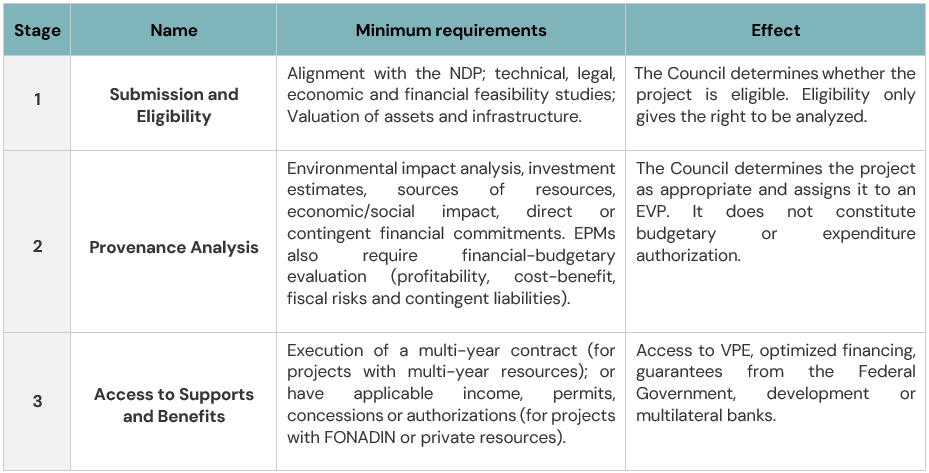
The Initiative establishes a three-stage process for a project to access the Support or Benefits provided for in the Law.
It is important to note that the participation of the public entity interested in projects for development with welfare under EPM must be approved by the Council, prior to the execution of the corresponding legal instruments.
The Law distinguishes between two types of incentives for projects that obtain the status of provenance:
C. Supports
Depending on the source of resources, projects will be able to access:
D. Benefits
A. Tenders
The general rule for awarding appropriate projects is public bidding, under the principles of legality, free competition, objectivity, impartiality, transparency and publicity. The direct or by invitation award to at least three people proceeds in cases such as:
For Strategic Investment contracts, the essential aspects are:
For any questions or comments, you can contact our expert team.
Legal Notice: This Client Alert is for informational purposes only and does not constitute legal advice or a formal opinion on any specific matter. The information contained herein reflects a general analysis prepared by our attorneys based on information available at the time of publication. Any reproduction, citation, or reference to this content must be expressly attributed to Mijares and should not be construed as a public statement or comment made by the firm to the media.
Awards







.png)