On May 1, 2026, an amendment to the Federal Labor Law (“FLL”) regarding working hours (the “Amendment”) was published in the Official Gazette of the Federation. This amendment seeks to align secondary legislation with the constitutional reform published on March 3, 2026, through which a new maximum weekly working schedule was established in Mexico.
In general terms, the Amendment introduces three key changes: the gradual reduction of the weekly working schedule to 40 hours, new rules regarding overtime, and the employer’s obligation to maintain an electronic timekeeping record.
Below is a summary of the main provisions established by the Amendment:
1. Reduction of the Maximum Weekly Working Schedule
As a result of the Amendment, the maximum ordinary working schedule recognized by the FLL will be 40 hours per week. However, this change will not apply immediately, but rather gradually between 2026 and 2030, in order to allow companies and employees to adjust their operations.
2. Daily Working Hour Limits
The maximum limits by type of shift remain unchanged:
This means that although the weekly cap is reduced, the daily limits already provided by law remain in force.
3. New Overtime Rules
The Amendment also redefines how the working schedule may be extended under extraordinary circumstances.
Overtime must be paid with an additional 100% over the ordinary wage (i.e., double pay). In addition, overtime may not exceed 12 hours per week, distributed in up to 4 hours per day, during a maximum of 4 days per week.
If that limit is exceeded, up to 4 additional overtime hours per week may still be worked, but such hours must be paid with an additional 200% over the ordinary wage (i.e., triple pay).
The combined total of ordinary and overtime hours may never exceed 12 hours in a single day.
4. Electronic Timekeeping Record
A new obligation is introduced for employers, consisting of maintaining an electronic record of each employee’s working schedule.
At a minimum, such record must include: (i) start time, and (ii) end time.
Likewise, it must be made available to the labor authority upon request.
The Ministry of Labor and Social Welfare (Secretaría del Trabajo y Previsión Social) will issue the general rules establishing how this system will operate, in which cases it will apply, and what exceptions may exist.
It is also established that, where it is proven that the content of the record was agreed upon between employer and employee, such record may have full evidentiary value.
5. Penalties for Non-Compliance
Failure to comply with the obligation to maintain the electronic record may result in fines ranging from 250 to 5,000 Units of Measurement and Update (Unidad de Medida y Actualización – UMA) (between USD$1,626.81 and USD$32,536.11).
6. Gradual Implementation (2026–2030)
The reduction of working hours and the gradual increase in overtime limits will apply according to the following schedule:
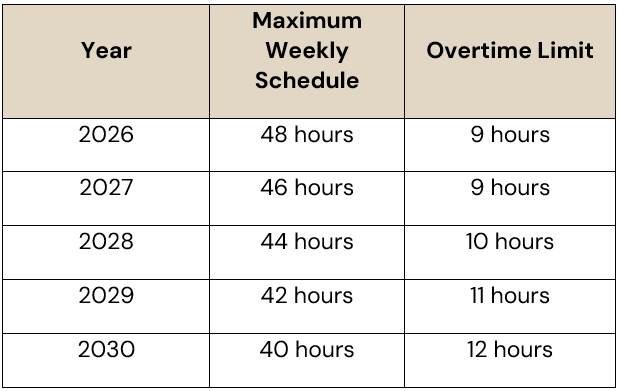
Additionally, the period from May 1 to December 31, 2026 will be considered a transition stage for companies and employees to adjust internal processes, schedules, and operational schemes.
Regarding the electronic record, the provisions issued by the Ministry of Labor will become effective as of January 1, 2027.
7. Protection of Salaries and Benefits
The Amendment expressly establishes that the reduction of working hours may not be used to reduce salaries, wages, or benefits.
This Amendment represents one of the most significant labor changes in recent years in Mexico, as it modifies the way working time is organized. For companies, it will require reviewing shifts, workforce structures, labor costs, and attendance control mechanisms; for employees, it represents progress toward better rest conditions and a healthier work-life balance.
For any questions or comments, you can contact our expert team.
Legal Notice: This Client Alert is for informational purposes only and does not constitute legal advice or a formal opinion on any specific matter. The information contained herein reflects a general analysis prepared by our attorneys based on information available at the time of publication. Any reproduction, citation, or reference to this content must be expressly attributed to Mijares and should not be construed as a public statement or comment made by the firm to the media.
Awards