On September 8, 2026, the Ministry of Energy (“SENER”) published in the Federal Official Gazette the Decree amending various provisions (the “Amendment to the Migration Guidelines”) of the Guidelines for the Voluntary and Expedited migration of Self-Supply and Cogeneration of Electricity to the figures established under the Electric Sector Law, published on June 18, 2026 (the “Migration Guidelines”). Among other matters, the Amendment to the Migration Guidelines extends the deadlines applicable to the Migration Procedure, modifies and streamlines certain requirements, and provides greater certainty regarding the continuity of electricity supply and metering requirements.
As background, the Migration Guidelines regulate the voluntary migration of self-supply and cogeneration permits granted under the Law of the Public Service of Electric Energy to the provisions set forth in the Electric Sector Law (the “Migration Procedure”). For further information on the Migration Guidelines, please see our article here.
The Amendment to the Migration Guidelines responds, among other factors, to requests from various industry participants for additional time to complete the corporate, contractual and technical actions required to complete the migration process, as well as for greater clarity regarding certain requirements.
Below is a summary of the main changes introduced by the Amendment to the Migration Guidelines.
1. Extension of the Deadlines for the Migration Procedure
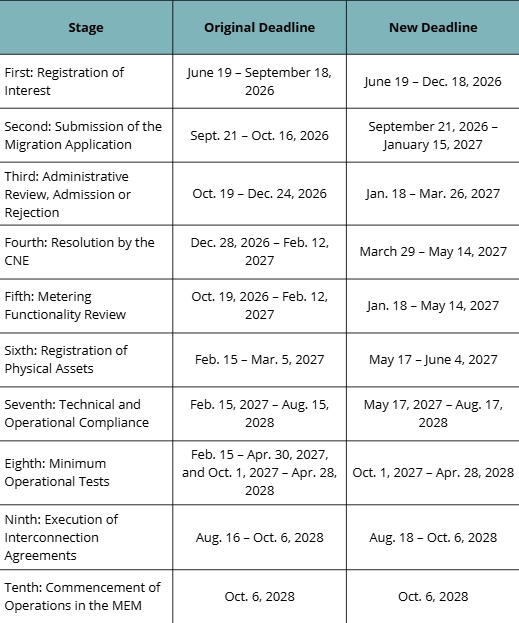
The most significant change is the extension of the deadlines applicable to the initial stages of the Migration Procedure. While the overall timeframe for the Migration Procedure—from June 19, 2026, to October 6, 2028—remains unchanged, the deadlines for registering notices of interest, submitting migration applications, and completing the subsequent stages have been substantially extended.
a. Generation Facilities
b. Load Centers

2. Flexibility in Requirements
The Amendment to the Migration Guidelines also modifies, and introduces flexibility in various requirements applicable to the Migration Procedure, including the following:
a) Connection studies for local loads. Local loads seeking to migrate to Qualified Supply must submit a request for connection studies to the National Center for Energy Control (“CENACE”) before submitting the migration application. CENACE will prioritize such requests.
b) Modernization Program: The modernization program may include modernization, testing or rehabilitation activities that have already been completed.
c) Integration of SAEE: If the applicant does not have the feasibility letter issued by CENACE, it may request such letter jointly through the Migration Window or demonstrate that the corresponding request has already been submitted.
d) Elimination of Minimum Demand Requirement: The condition requiring load centers migrating as qualified users to meet a minimum demand threshold has been eliminated.
e) Accreditation of Market Participant Status: To evidence market participation, it will be sufficient to submit a letter of intent executed by the relevant parties or state, under oath, that the Market Participant Agreement is in the process of being formalized. The agreement must be executed before the sixth stage for generation plants or the seventh stage for load centers, as applicable.
f) Early Scheduling of Minimum Operational Tests: Applicants that have registered an expression of interest may request CENACE to perform the tests on a date other than the date established in the applicable schedule. CENACE will evaluate the request and may authorize the proposed date.
3. Continuity of Electricity Supply
The Amendment to the Migration Guidelines include relevant clarifications regarding the continuity of electricity supply during and after the Migration Procedure:
a) Legacy Regimes that do not migrate. Load centers associated with a Legacy Regime that do not migrate or complete the Migration Procedure may continue receiving electricity under Basic Supply regime.
b) Local loads. Local loads resulting from migrating to self-consumption may retain their Basic Supply contract.
4. Metering and Shared Substations
The Amendment to the Migration Guidelines also provides greater flexibility with respect to certain requirements related to metering systems:
a) Load Centers under 1 MW. Load centers with a demand of less than 1 MW may continue using their existing metering equipment after migration, provided that such equipment complies with the minimum required metering functionality.
b) Equipment Compliant with Market Rules. Generation facilities and load centers whose metering system components comply with Market Rules may continue to use them, regardless of who owns them.
c) Shared substations. Load centers may continue to share a substation, provided that each load center has the minimum required metering.
5. What’s Next?
The Amendment to the Migration Guidelines entered into force on September 9, 2026. Applicants that have already initiated the Migration Procedure have 10 business days to confirm whether they continue to abide with the original deadlines; otherwise, the new deadlines will apply to them.
New applicants must register with the CNE’s Electronic Filing Office before the fourth stage of the Migration Procedure.
The key milestones are:
• December 18, 2026: deadline to register a notice of interest.
• September 21, 2026, through January 15, 2027: period for submitting migration applications.
• October 6, 2028: end of the Migration Period.
For more information on the Amendment to the Migration Guidelines and its implications, please feel free to contact our team.
Legal Notice: This Client Alert is for informational purposes only and does not constitute legal advice or a formal opinion on any specific matter. The information contained herein reflects a general analysis prepared by our attorneys based on information available at the time of publication. Any reproduction, citation, or reference to this content must be expressly attributed to Mijares and should not be construed as a public statement or comment made by the firm to the media.
Awards








.png)